
Across the country, communities are investing in safer streets, slower speeds, and more people-centered transportation systems. From quick build traffic calming treatments at dangerous intersections to lowering speed limits on high-speed corridors to partnering with state agencies to tackle high-injury, state-owned roads — local leaders are showing that when and where we invest in safety, we see progress. Many of these are small-scale successes, happening at the micro-local level — the kind of stories that don’t always make major headlines, but offer big lessons about what it will take to build momentum on Vision Zero.
The Vision Zero Network team was excited to hear directly from leaders across the country — from Oakland to Cleveland, Arlington to San Antonio — who are actively implementing these efforts, while we participated last week in the National Association of City Transportation Officials (NACTO) Designing Cities conference, held this year in Washington, D.C.
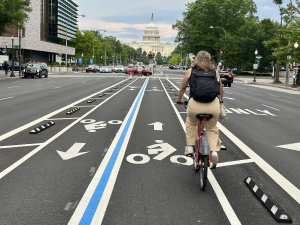 Woman bikes in a two-way bikeway in downtown Washington D.C. This is just one of many safety improvements happening across the city.
Below, we share our insights from valuable time spent with so many safety leaders: first, an inspiring number of cities are investing in safety on the ground and seeing results; and second, we’re seeing a growing appetite to scale up what works.
Encouraging Results: Progress Already Underway
Despite challenges, localities are putting proven road safety strategies to work on the ground. While these don’t always make headlines, even small investments in safety are yielding results. We heard inspiring examples ranging from cities doubling down on managing speeds for safety, streamlining their project delivery processes, and reimagining their street space for safer mobility for all. Here are a few examples of recent, local progress that we’re excited to spread the word on:
Washington, D.C.’s is improving safety on its streets thanks to its investments in Vision Zero strategies, especially where the city is prioritizing redesigning streets on its High Injury Network and where multimodal uses are greatest. We were impressed to see many corridors significantly upgraded with bright red transit-only lanes, along with physically separated bikeways and new on-street bike corrals, along with vastly improved pedestrian space – and, often, beautiful street art as well!
Taking a proactive, Safe System approach, D.C. has standardized key safety features like leading pedestrian intervals, which are now in more than 80% of the city’s intersections. These and other safety changes are yielding measurable results! Washington, D.C. is on track to see a drop in serious traffic injuries for the fourth year in a row, and traffic fatalities are lower than in any year since the city committed to Vision Zero.
Other recent road safety highlights in D.C. include the following:
- Narrowing travel lanes and adding a two-way protected bike lane on G Street NW has led to an 86% decrease in pedestrian injury crashes and a 60% reduction in all injury crashes.
- Removing a travel lane and installing a protected bikeway on Virginia Avenue NW resulted in a 50% drop in total crashes, a 108% increase in biking, and up to a 39% decrease in vehicle speeds during peak hours.
- Converting general travel lanes to bus-only lanes and adding separated bike lanes in both directions on Pennsylvania Avenue SE has helped reduce pedestrian-involved crashes by 100%
 Traffic calming projects in Washington D.C. are making walking, biking, transit and driving safer across the city.
Seattle, WA has achieved a 48% decrease in crashes involving a turning vehicle and a pedestrian, as well as a 34% reduction in serious injury and fatal collisions at intersections with Leading Pedestrian Intervals (LPIs). The city has been prioritizing adding LPIs, which are now in place in more than 80% of city intersections. Preliminary data for 2024 suggest that Seattle may achieve zero traffic fatalities for bicyclists and a reduction in pedestrian fatalities.
Milwaukee, WI: The city piloted a temporary neighborhood traffic circle as part of its efforts to slow speeds and improve safety on residential streets. Before the installation, 18% of drivers were traveling at 35 mph or faster on a street with a 25 mph speed limit. After the traffic circle was added, that dropped to less than 1% — a 95% reduction in the number of speeders. Based on these results, the installation was made permanent.
Arlington, VA: Quick, tactical on-street safety improvements, such as adding centerline hardening using flexible posts and mini speed humps, have helped decrease the rate of vehicles crossing the centerline from 38% to 5% and increased the percentage of drivers turning at less than 10mph from 10% to 26%. Arlington recently studied the impact of various speed management strategies and found that roadway redesigns were the most effective in significantly reducing dangerous speeds. However, their analyses also revealed that speed limit reductions and added signage did impact speeds and therefore still play an important role as part of a broader strategy. Building on these findings they will be focused on piloting other arterial speed management treatments.
Cleveland, OH: A successful pilot of speed tables that showed average speeds dropped by 7.8 miles per hour across test sites. As a result, Cleveland began scaling up its efforts citywide. In 2024, the city installed 100 speed tables and plans to add another 100+ in 2025. The measurable impact of the pilot helped build strong local momentum for traffic calming, with growing support from the State Department of Transportation as well. The state is now encouraging more Ohio cities to adopt proven speed management strategies, including raised crosswalks on arterial roads, to deter dangerous driving and improve safety.
Alexandria, VA: With 8 road diets completed and a majority of city streets’ speed limits lowered to 25 mph, Alexandria is seeing how steady safety investments lead to life-saving results. Alexandria recorded zero traffic fatalities in 2023 — a powerful sign that their Vision Zero efforts are working. Now, with slower speeds and growing community confidence, they’re gearing up for even bolder, more transformative redesigns.
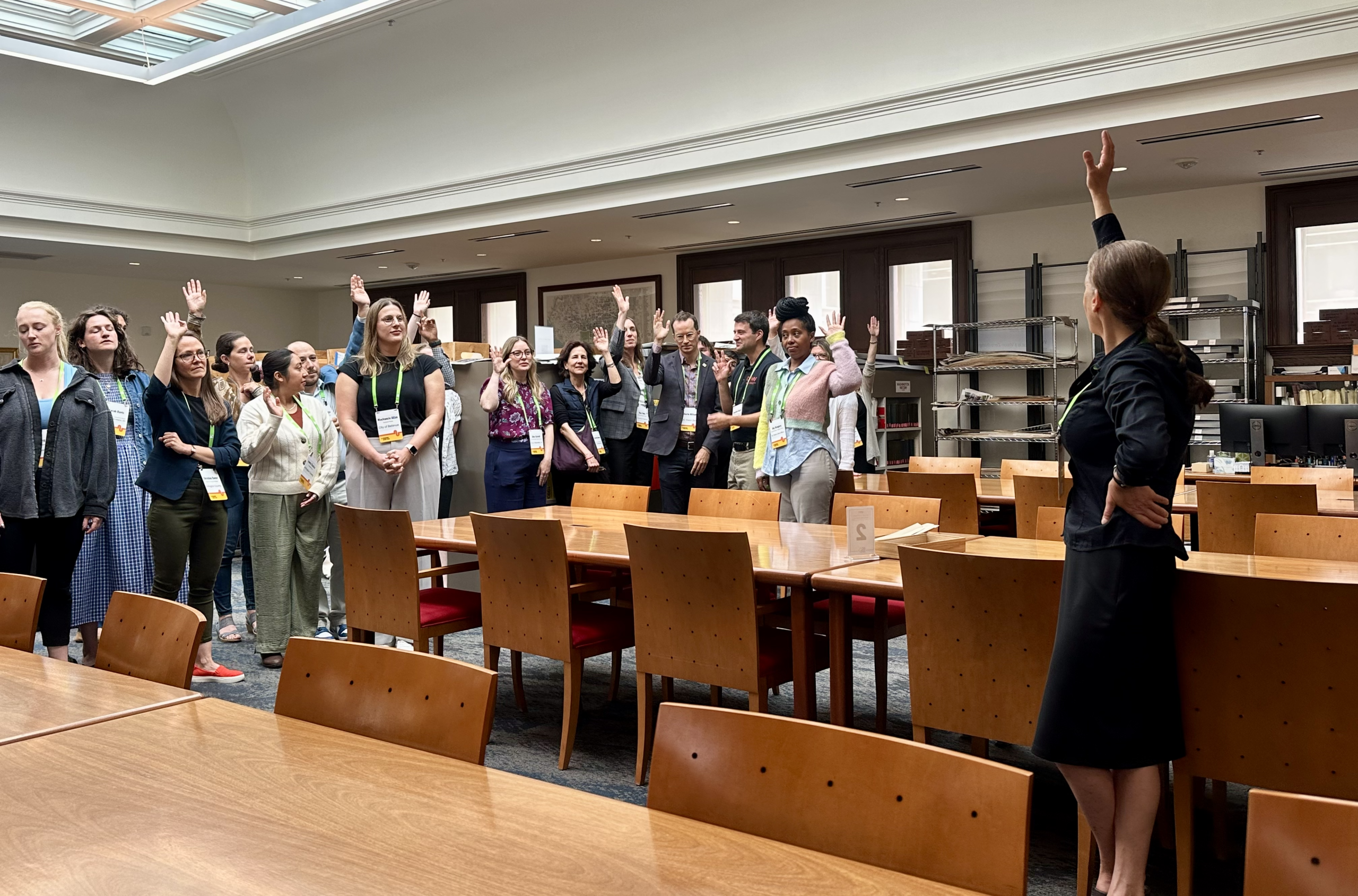 Vision Zero leaders from 23 cities across the U.S. shared their experiences at a Vision Zero Network peer exchange meeting in May 2025.
 Vision Zero Network team from left to right: Leah Shahum, Tiffany Smith, and Jenn Fox participated in the NACTO conference in DC. We led a Vision Zero peer exchange and Happy Hour, joined walk tours, and learned from Vision Zero leaders across the country about their many road safety successes.
What’s Next: Scaling Up What Works
We’re encouraged to see local Vision Zero leaders try new approaches, introduce their communities to strategies that have worked elsewhere, and build on their learnings. Even at a relatively small, micro-level, these safety investments are making a difference.
The next phase is to build on these successes (more examples) by scaling up what work citywide. Another key step is to shift to a more comprehensive, proactive approach to prevent crashes before they happen (a core element of the Safe System approach). Whether you're just getting started or looking to build on existing efforts, we hope these real-world strategies offer inspiration and practical lessons to help your community.
| Check out these related resources: |